Showing posts with label social. Show all posts

Teaching kids independence and letting go


As our girls get older, we are trying to encourage their increasing independence.  Although they are only 6 and 8, there are lots of things that they should be doing by themselves now- and I'm finding I need to be better at letting them do these things!

I take them to school each morning, and go to each of their classrooms with them.   They sort out their own books, water bottles and whatever else needs doing at the beginning of the day - but they are still happy for me to be there and to say hi to their teachers and their classmates.  I like that I still feel a little involved - know where they sit and get to see some of their work.  There are however, many of their classmates and friends whose parents just drop them at the school gates and the kids take it from there.

I have noticed that kids whose parents drop and go; and those kids who go to before and after school care, are kids with a certain self-confidence.  I guess without Mum and Dad always there to fall back on or turn to, they have learnt to stick up for themselves!

In comparison, I notice our girls are a little more shy, and do turn to me for reassurance, and to ask things. Perhaps this is simply just because I'm there - and they would be equally self-confident when I'm not there -but obviously I can't see that!

I don't think of myself as a 'Helicopter Parent' I do try to step back and get our girls to do things by themselves wherever possible, to help them gain more independence and confidence.  I'm lucky enough to be a stay-at-home mum, I know many parents have to work and would love to have this time with their kids but circumstances won't allow it. But I'm also aware of the fact that our kids are growing up and I need to start stepping back a bit.

One example is their after school swimming lessons. The pool is at their school, so very convenient and easy for kids to go up there by themselves after lessons.  Until this year, I always came in and walked up with them, but at the beginning of this year I decided to get them to go up together, and I'd meet them there later.  They have to make sure they have all their swimming gear in the morning before school, then when they go up to the pool, they have to sign themselves in.

The first time they did it - I arrived just as they were signing in, and they were less than impressed as they were enjoying doing it 'all by themselves'.  Another time I arrived early as one of them had forgotten their cap - so they didn't mind that.    After a few weeks they're now happy to go up on their own, but are equally happy if I meet them and we go up together.

You see, I enjoy spending that time with them, I get to hear about their school day as we walk up to the pool.  Plus if I meet them out of class, I also get to chat to the other parents too as I wait!  That's my little social part of the day!

I asked the girls if they are happy with me watching them swimming each day, and their answer was a resounding yes! I'm going to enjoy this now as I know as they get older it may change!

At a swimming carnival recently, Euan and I were running up and down the sidelines of the pool cheering our girls on in their races. Another parent remarked that they remembered when they could do that for their son - but now he's a teenager, they have to sit and watch in the stands - and not embarrass him!

I love being a part of our daughters' lives - helping out at school and watching them in their endeavours -whether it's a school assembly, class activity or sporting event.   I know at this stage they want us to be there and appreciate our support. (see the picture above which one of them drew and wrote for me after I came to school to help one day!)

Whether this means that it will slow their independence and growth of confidence, I don't know.  But there are enough people with older kids who constantly tell me to enjoy this time as the kids grow up too quickly!

So I'm going to do just that! Both we as parents and our kids want us to spend time together now. Long may that continue!  and I'm sure that in itself is boosting their self confidence too!

How about you ? Are you a so called 'Helicopter or Lawnmower Parent" - one who hovers over their kid to make sure everything is ok - or pushes all obstacles out of the way of their child to 'help' them ?   Or are your kids very independent and do they like to do things by themselves, not wanting Mum and Dad there anymore ?

I'd love to hear your opinions and stories!


Learning to push yourself


Here in Australia, the Biggest Loser TV series is on again. This is a family favourite for us - our girls love watching it and I think it is a good thing for them to watch and be aware of what can happen when you let yourself and your body go, when you don't exercise or eat healthily


Watching the show this year, I've particularly noticed how much the trainers are telling the contestants to push themselves out of their comfort zones.  They have made comments, that some of the contestants , particularly the younger ones, have never done this before and don't know how it feels to push themselves.

I believe that learning to push yourself is something that every child should learn at a young age. 
When something is difficult or painful, by far the easiest option is to stop, to give up.  But knowing when and how to push on, helps develop skills of determination, confidence and that of overcoming fears.

In watching our girls as they grow and encounter new things, I see their reactions of both fear and refusal of trying something new, and that of excitement and wanting to have a go.  

Both our girls have experienced both reactions in different situations and at different times, but character-wise one daughter is more prone to the fear than the 'have a go' attitude, and we do our best to help her overcome this and to learn to push herself out of her comfort zone.

There have been times when I've felt like a cruel pushy parent  in getting her over a mental hurdle of not wanting to participate in something. (and I'm sure people watching would have perceived me as such).  But the end result has been worthwhile as I've seen the joy and delight on my daughter's face as she realises she can do these things -and even better, enjoys them!
The older she has got, the better she has become in pushing herself in situations that may be new or scary and I am proud of her ability to get out of her comfort zone

I think part of learning to push yourself, is learning about consequences of your actions.  Watching the Biggest Loser, you can see this clearly over the series as you watch the contestants pushing themselves physically and mentally; the pain this causes them and how hard they find it - but in the end the amazing transformations starkly show the clear benefits of their actions.

In relating this to our kids, I think of academic work - of times when our daughters don't want to do their homework, or spelling practice.  They are now beginning to understand the reasoning behind the practice and it's benefits in class as their confidence grows and test results improve.  

As a child, I remember my father giving me extra Maths and English work to do each week. It wasn't much, but I never enjoyed it.  However, I do remember liking being a little bit ahead at school often and grasping concepts quicker, having already covered them at home with my father (who was a teacher himself).  In hindsight, I am grateful to my father for the time he spent helping me push myself at a young age!

As with everything it is important to find a balance and not push your child too much.  I hope we achieve this balance and our girls grow up to be both confident and determined with an ability to go out of their comfort zone to move forward and achieve their desires in life.

Do you push your children?  Do you believe children should be pushed?


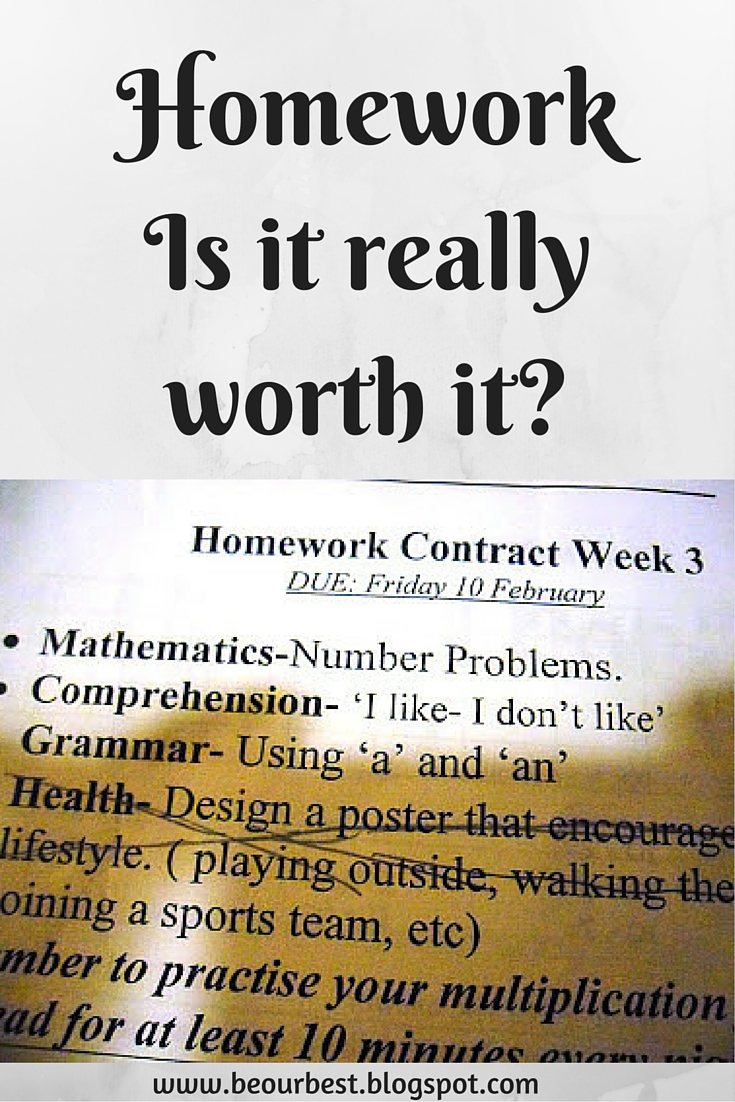
Homework - is it really worth it?


Our two girls are now back into the swing of school after the long summer break.  Homework started last week for the eldest, and this week for the youngest.  Both are expected to read each night, and record what they read to show the teacher.They also have spelling words to learn each week, and Maths and English work too.  This homework, together with after school activities makes for a busy time - but there is still plenty of time for play, and I am happy with the amount of work they are doing.

There are state policies on the subject of homework. I had a read of our Queensland policies and saw that in Prep (the first compulsory year of school here) generally no homework is set.  I remember our youngest daughter wanting homework when she was in Prep as her older sister (2 years age difference) was then getting homework.  At that age, homework can sound like fun.  I remember wanting the same as the youngest child - and our teacher giving us homework like - "bring in as many different types of paper as you can"  or we made a paper basket in class, and we had to fill it with as many things beginning with 'b' as we could! Fun homework!
As the school age increases, so does the expected amount of homework.

I know many people don't like the idea of homework - there are arguments both for and against.
While researching these arguments, I found an entire book written about the case against homework! which states that,

"it is a hidden cause of the childhood obesity epidemic, creating a nation of "homework potatoes."

Personally I think this is a bit extreme - but then that's my opinion

 based upon the homework our girls get, and remembering my own

 experiences of homework as a child.


I believe that homework is an important way for children to

 reinforce things they learn at school, and also a way for parents to

 see their child's progress and what they are learning at school. It 

also provides the children with a chance to work independently.

Sometimes, children may not have understood explanations and

 concepts in class, and then difficulties arise when they have to

 complete tasks for homework.  But this provides an opportunity to

 learn about consequences - the importance of listening in class;

 learning to ask questions when you don't understand things; and

 even learning to research things yourself - asking parents for help,

 checking in books or online for help.


I think there are many things that will influence how you feel about

 homework. Each country and indeed school will set differing 

amounts of homework for children, and have differing 

expectations.  


What do you feel about homework? Do your children get enough?

 too much?  What about your own memories of homework from

 when you were a child?


Losing my voice


Last week I lost my voice - totally, for 4 days. It wasn't just croaky, it was completely gone. Our two daughters are currently home on school holidays, and the day my voice went, was the day Euan returned to work after his Christmas break.

The first day wasn't too bad. I felt very unwell, but our girls are pretty self sufficient and managed without much input from Mummy for the day.  They played together, helped make lunch and watched a movie while I rested.  When I needed to communicate with them, I wrote notes (thankfully both of them can read) and used signs.

By day two I began to get frustrated.  I couldn't catch their attention without going to them, the usual stern tone of voice saying their name if they began to push boundaries with each other or me couldn't happen. Facial expressions only work when they're looking at you.  Trying to help them do things was difficult trying to write explanations isn't as effective as spoken ones. Most frustrating was the fact the the girls weren't speaking to me.  I was trying to use sign language, and so they were doing the same back to me. When I mouthed words to them, they mouthed replies back! 

The first day I lost my voice, I didn't expect it to last, so didn't consider how to cope with silent parenting. Euan came up with an idea after work the second day.  When he returned home he downloaded an app onto this new tablet that would translate my typing into spoken words!  Ironically when  I was finishing cooking dinner and trying to catch everyone's attention by banging on the kitchen bench, then banging a glass with a spoon - everyone ignored the noise - and me, because they were too busy playing with this new app that was supposed to help me communicate!  Doubly frustrating - and I'm afraid tears ensued after a very long day!

The app on the tablet did at least make a little light of the situation.  Typing wasn't really any faster than me writing what I wanted to say - and the pronuciation wasn't always understandable. Plus it was new and exciting to the girls so they would watch me type and read out what I was typing before the tablet had a chance to say it for me!  Still, it did provide some light relief of the difficult situation for me, as we played around with the speed and pitch of the tablet's pronunciation, and made it say silly things!

Not being able to speak for four days, made me realise quite how much I do normally speak.  Not just conversations, telling and asking things, but also just little comments and words, voicing my thoughts, and also singing along to songs on the radio. I love to sing with the girls and I've been missing that!

I also found that people do tend to speak to you in the way you speak to them.  Aside from the girls themselves mouthing and whispering words to me, when I ventured out to the shops while unable to speak  I found shop assistants doing the same  - then shaking their heads and speaking properly. I don't think anyone did it consciously, but it was another thing I did find frustrating!

After two days of not being able to speak to my kids, I started to wonder how long this was going to last, and how could I cope with it better.
It made me think of 'baby sign language'..  I remember reading about it when our daughters were both speaking, so really it was bit late for them, but it seems like a good idea.  I wonder if babies who are taught this type of sign language, then find non verbal communication any easier when they get older?

It also made me think of the game of charades.  We've never played it with our girls, but this experience has made me feel that we should!  Perhaps last week would have been easier - and maybe a little more fun, had I been able to use principles from charades to communicate more?  Maybe not, but if nothing else it would be a fun game to play with the kids.

Losing my voice and having to parent silently for 4 days did make me look at how I do things, and what I would like to do differently.  One thing I want to do is to get the girls more actively involved in the house - doing more chores, and helping out more.  This is one area I'll definitely explore this week - and figure out what is possible!  Watch this space!

Have you ever lost your voice? How do you think you would cope if you couldn't speak to your kids for a few days?


Routines for kids- the good and bad


After reading this article on the BBC news website about how kids with a routine of set bedtimes and mealtimes do better at school, it got me thinking about routines. What routines do our kids have and what did I have as a child?

I certainly did have structure, and our kids do have set routine times for the basics of getting up, mealtimes and going to bed - these are more flexible in the school holidays of course!

One of the comments on this article surprised me - someone stated that changing TV schedules haven't helped parents keep routines! 

I think that parents need to be aware of their children's needs and able to be in control rather than affected so much by outside influences like TV schedules, or opinions of others.  I believe that we as parents need to demonstrate control of our lives to enable our children to develop a responsible control over their own lives. 

I'm not saying that we aren't influenced by outside factors, but our lives are not controlled by them. 


Thinking about routines in the middle of a 2 month summer break from school is interesting.  Our girls are very rarely at a loss for something to do. They play very well together and have endless imaginary games to keep them amused - or immerse themselves in books, craft or play outside in the swimming pool or just the garden.  But after 4 weeks of holidays I had decided that I wanted to introduce a bit more routine into theirs - and my day. Some time spent exploring their new laptops - a little time playing some games that will keep their brains working while away from school, and also time to get active.  However, starting the new year with these great plans - but losing my voice and being sick hasn't helped us get stuck into the new routine!

The aforementioned article from the BBC states that children with more structured days grow up more confident and with more direction in their lives.  I think routine is just a part of this - but an important part.  Kids need structure and order - but there also has to be a balance.

Several years ago I worked as a teaching assistant in a school in Japan.  I learnt how structured children's lives are in Japan - for example I remember reading a school trip schedule in which every minute was accounted for, down to the times to clean their teeth, get dressed and brush their hair! There was no freetime on that schedule.
 I also remember reading an article about what Japanese teenagers worry about most.  Very high up on the list was 'having free time'!! Simply because they did not know what to do with it!   
Now I'm sure this is not the blanket case across the whole of Japan, but it demonstrates the effect that too much structure can have on children.  They need to learn to think for themselves - but you have to give them the tools to be able to do this sensibly and morally.  That is a parent's job - to provide routines, structure and boundaries within which a child can grow and develop. These children will then eventually learn to push and shape those boundaries and structures to suit their own lives and characters. 

Meal and bedtime routines are important basic foundations that all children need and should have.  Routines beyond that I think depend on the time, (school or holiday) and personal choice of how you want to bring up your own children.

Personally I feel like I would like to have a little more structure and routine in my life - and if I can manage this - and include our kids in that, I would achieve a lot more than I do now.  But once again - balance is key! I certainly don't want to schedule activies into every minute of their holidays - but a little direction and a little more shared time would be a good thing!  Now I just have to get my voice back and we can get started!

How about you?  How much routine do you put into your child's day?  Are you happy with it? How does it compare to your own childhood routines? and is routine a good or bad thing?


Kids playgrounds have become too safe


A few years ago (2011) in an interview on ABC radio, an early childhood expert - Prue Walsh, spoke out saying Public playgrounds have become too safe.  She believes that the influence of insurance costs and the fear of councils and schools being sued are part of the problem in making playgrounds unimaginative and too safe for our children.

I agree with her opinion completely.  I recently watched a TV programme called 'Lost Adventures of Childhood' which covered this very topic of discussion.

I certainly remember playgrounds being a lot different when I was a child.  My local park had a row of four swings, a roundabout and a large slide.  Todays playgrounds don't seem to have as many swings in a row, nor go as high as the ones I remember.  Nowadays, playgrounds are more brightly coloured, with a lot more rails and enclosed parts. They are more restrictive and allow less scope for imagination.  Playgrounds used to be very simple and encouraged children to be imaginative in their play and to take risks, with high swings and jumps.  

So are risks a good thing? Do more risks mean more injuries and more broken bones?  I think these would happen anyway.  Kids will always find places and ways to take risks, and if they don't find this in playgrounds when they are young, then where and when will they start to take those risks?

I think that generally today there is a tendency to over-protect our children.  Kids 'go out and play' far less than in previous generations, partly due to the advent of computer and video games, but also because parents are aware of the dangerous nature of the world we live in thanks to the ever present media.  But is the world really any more dangerours than in the past- or are we just more aware of those dangers?

By not letting our children take risks, how will they learn where the boundaries of common sense lie?  How will they learn to think for themselves and become adapatable and self-confident?

Making playgrounds safer and subject to more rules and regulations is also detremental to our kids physical development.  Play is nature's way of making sure we learn necessary skills.  A few years ago I remember a friend being told to take her child to a park and tell him to climb the wrong way up a slide in order to help him improve his underdeveloped motor skills.  Kids should not need to be 'told' to play and experiment, it should be a natural part of their lives.  I see skills being 'taught' in schools now - like balancing and climbing.  Surely kids should already have acquired these skills by the time they start school!

Are we stunting an aspect of the growth of our children in trying to protect them?  Injuries, scrapes, bruises and even broken bones are a part of a regular normal childhood.  Patterns of behaviour are leant from risk taking and from making mistakes.

At the end of the TV programme I mentioned earlier (Lost adventures of Childhood)  mention was made of special adventure playgrounds that have been built in the UK, which provide a structured and supervised place for children to take risks.  Basically it's like taking them back to what playgrounds used to be like! 

It seems  that we are now coming full circle and realising we have taken the real 'play' out of playgrounds.  Hopefully playgrounds will start to return to the real adventure playgrounds I remember from my childhood, and our children can be allowed to play as nature intended again!

Do you agree?  Or are you happy that playgrounds have become so 'safe' now, and children are less likely to hurt themselves there?


Child beauty pageants - why not?


A while ago, across Australia, people rallied against child beauty pageants. A group called "Pull The Pin on Pageants" organized these rallies in every capital city across the country, concerned about the way these beauty pageants portray women and young girls. This came in response to news that an American company had decided to bring its pageant to Australia for the first time.

We've all heard about the extreme cases of parents taking their children to have their eyebrows waxed, fake tans applied and pushing their children to strut about on stage to fulfil their parents ambitions, and financial desires. But is it really the pageants themselves that we should blame and try to ban?

There are countless beautiful baby contents in shopping centres and promotions for photographers and baby products. Why are these not considered so controversial? Is it because they are non gender specific? It is still a case of the parents dressing up their child for a competition - the baby or child has no say in whether or not they want to participate or not, or have their photos published in a national magazine.

But this is the role of a parent. To bring their child up the way they seem fit. To choose which clothes their child wears when they are very young. To decide which school to send them. To choose what food they will eat and which friends they will play with. A parent is meant to have control over their child when they are young, and this control lessens as the child ages and takes more responsibility for themselves - responsibility and choices made from morals and values instilled in them by their parents. To impose an age restriction on beauty pageants, as many people would like to see happen, is like saying no parent is fit to make decisions for their own child.

Of course there are both good and bad parents, and everyone's opinion on what makes a good or bad parent varies.

I think we underestimate the influence a parent has on a child, and nowadays, external influences are blamed far too much for problems. Girls who develop eating disorders, may blame the trigger as being a comment from their dancing teacher at a young age, telling them they should eat less to stay slim. I myself did gymnastics for years as a young girl, and remember a coach telling me to watch what I ate - but I have never had any eating disorder problems. I believe my parents brought me up with a healthy respect for by body, my diet and my appearance.

There is also the argument that a child who does not win a beauty pageant is being told they are not pretty enough. Any competition has winners and losers. Is beauty not in the eye of the beholder? One work of art may win awards and accolades from some critics, but be torn down by others. Some children may cry when they do not win a simple colouring competition but does that mean the competition itself is to blame for that child feeling upset? Competition is healthy, and a natural part of life.

Yes, child beauty pageants I'm sure, will inevitably have entrants who are pushed, primped and preened by ambitious and overbearing parents, who have little regard for their own child's feelings. Some young girls will dress up like adults in high heels and short skirts with make-up on. (If you're female - tell me you never did this with your mum's heels and make-up!) But does this pushing from parents not happen in every area- from sports to academia? We can't ban everything, to try to stop pushy parents!

I say let the kids dress up and have fun doing it.


Article first published as Child Beauty Pageants Coming to Australia on Technorati.

Kids telling lies


It is interesting to look at when, how and why kids lie, learn to lie and choose to lie.

Simply, we teach them.
Don't tell daddy we ate the last chocolate, Wasn't that dinner delicious (yes, after all the burnt bits were scraped off and it was covered in tomato sauce), no mummy your bum doesn't look big in that etc!

Our newly 6 year old has now found lying and doesn't even really understand or notice that she is doing it. It is natural for a kid to want to please their parents, not make mistakes and certainly not be caught out.  Nobody wants to knowingly be seen to do something wrong or admit to doing the wrong thing.
My most current example is such a small one but one that really makes me smile and I am sure one that will stay with me for some time.  Let me share.

It is close to bed time.  Our youngest is tired but still acting like a big girl and wanting to stay up late like the big ones.  It inevitably gets to shower time, what a big girl, she can do it herself now. Time to put on pajamas- great, well done.  OK, off to brush your teeth.  Back through to the living room to give a goodnight kiss.  Uh oh, no kiss for you, there's toothpaste all over your mouth.
"Did you clean your mouth after brushing your teeth?" (OK, a bit of a silly obvious question, but you have to make the kids think!)
Answer "Yes"
Question "Are you sure"
Answer "yes", so if I go through to the bathroom, I will find the towel clean and not half covered in toothpaste?"  "Yes".  "OK, Last chance- I don't want you to lie to me......... "  "Well, maybe......."

You have to smile, but the slippery slope has to start somewhere.

It makes me think, there are so many times we actively lie and a white lie is the accepted and chosen way for interaction but equally, lies lead to hiding more serious issues.
Did you take it?  This is potentially hiding theft.
Did you break it? Not taking blame and avoiding taking responsibility for the consequences of your actions
And the list goes on.


When did you last lie?  Was it a white one or a snowballing one that got out of control?
When have your kids lied?  Was it funny or more serious?
Can you even imagine life if no one told a lie?

Euan

Smacking children


There's nothing like a good smack!


I strongly feel that in the correct situation, a smack is a good deterrent and also provides a poignant reminder of inappropriate actions.  Obviously, beating a child, repeated hitting and having a child live in fear of a slipper, belt or other implement is NOT appropriate in any circumstance.


Is it hypocrisy to teach children not to smack or lash out at others by smacking them yourself?  Generally yes, if a parent smacks their child the likelihood of the child seeing this
as acceptable behaviour has been increased.   If all problems were initially solved by physical violence the playground would be a truly unhappy place.

A holistic approach is surely the only way forward with smacking as the 'death penalty' of the household rules system- the ultimate deterrent.  If the parents set the correct example of how we treat each other and mutual expectations, the likelihood of a situation leading to smacking is already reduced.  Talking about unacceptable actions, 'don't bite' and showing the consequences and asking the child to put themselves in the particular situation is a good first step.  From there, a loud clap, withholding either treats or fun activities would be the next step and then either a 'naughty corner' or chair or exclusion to the bedroom/laundry room could follow.  Each of these strategies must of course be accompanied by a discussion to ensure the child understands what was not acceptable and how they could better have dealt with the situation.  This has got to be the preferred option.

What about when the toddler takes a metal fork and decides to see how well it will fit into an electric socket?

Here, in my mind, a smack is appropriate.  There needs to be a lasting reminder of this DANGEROUS action.  A toddler may not have the vocabulary or reasoning capabilities to discuss the rationale of electricity but they will more likely associate the electrical point as a no go area.  In a situation where there is danger and a young child, smacking is an option.  Also as an ultimate deterrent which is very rarely used, the threat or understanding that a child could be smacked for unacceptable actions is important.  A parent has to follow through with discipline the same way as providing a consistent bed time routine, answer to requests for sweet food or can I have a ..... on a day to day basis.

The older a child gets, the more sit down, discussion and providing alternatives to the action they have taken eg. suggesting walking away, reason or diffusing a situation are ways to prevent situations that would have lead to a smack.  It is obvious that smacking does not have a place in adult life, although there are some people and bosses who probably would benefit from a good smack, children see it doesn't have a place in everyday adult life.  We have to guide our children towards this understanding and correct form of social convention.


As a smacked child and a smacker, my understanding is that hitting or abusing a child is very different from a smack to show something is dangerous or unacceptable.

How about you, do you agree or am I a violent parent who needs to keep my hands to myself?

Euan

Pink nails on boys- J Crew article


It isn't often that a news article really gets inside my head!

This one which simply has a photo of a young boy with pink nail varnish on his nails in a child's brand of clothes advert really makes you think. Not at face value, but when you look at some of the discussion and delve a little deeper, some of the implications begin to make you ask questions.

The article was in the Wall Street journal.
It is really worth a look and the comments just keep on coming.
It even spawned further discussion through 'The Mad Momma'
another blog I enjoy.

In my mind, pink for girls and blue for boys is rubbish.  Kids like bright colours and it is often dependent on their characters as to how much attention they wish to pursue.  BUT, and it is a big but, you cannot look at society without accepting the gender connotations that match with colour.  These are so strong that children will throw tantrums if they don't have their favourite colour top or decide they are not thirsty if the drink is in the wrong colour cup!

I think parents need to lead in terms of pushing children to make their own choices but also be aware of the societal expectations.  It is important to have gender differences, I still believe that a boy should be a boy and a girl should be a girl.  Yes, as defined by society, but it allows you to enjoy the colours of grey in between too when you are happy with the understanding of who you are.

The point of this article, again in my mind, is that a parent perhaps should not portray their son in pink decorated and painted nails on a world stage.  This is close to exploitation.  The parent understands societies connotations, the child does not.  The child however is subject to peer pressure and all the negativity that potentially surrounds his parent's choice.
Young children are not trend setters, multi national marketing companies are.  Whilst they can manipulate kids into tweens wanting padded bras and boys wearing Ben Ten merchandise, a parent has to be more circumspect.

The idea of gender and how it can and has been manipulated by society is fascinating.
I think roleplay for kids is great fun and important.  I think fathers having play fights with their daughters and painting boy's toenails with rainbow colours is great in the family home BUT on a global scale, sometimes there is a need to have closed doors for exploration of what a child wants to wear, do and how they act in public.

What is your take on this?

Euan

The Art of Conversation - Conversation Coasters


 As our daughters have grown up, they have become more and more interested in hanging around at the dinner table beyond meal times to hear and join in with the adult conversations!

Since they have begun to show such an interest, I thought I would make up some 'conversation coasters' to help make dinner time a bit more fun and also to help develop their conversation skills.

We always have asked them questions at meal times, for example about what they have done that day; but now they are in school, we often get the response 'nothing', (which I understand is quite common amongst school age kids!)  So by putting the questions into a different form, and making it more like a game, we've found our kids actually want to tell us things!

Conversation skills are a difficult thing to teach your kids. Thinking of topics to talk about, knowing when to interject to make a comment, how to change topics etc. 

These coasters have proved to be a big hit with our girls.  Each night they are happy to set the table for dinner - as they then get to choose who gets which question - or sometimes they do it randomly - placing them upside-down so nobody knows which question we all have until they have been turned over.

We then choose somebody else to ask that question of, and usually it sparks more of a discussion, and sometimes others want to answer the same question too.

Here are the questions I made up on this first set.

I do plan to make more conversation coasters now and again, to add to the selection.  As the girls grow older, I'm sure the type of questions we have will grow with them.
 I have also made a set of ones for dinner parties, which are more 'grown up', with 'big questions' like 'Is there likely to be another World War?'!  Well, why shouldn't we join in on the fun too!


Do you have any different ways of starting conversations with your kids, or teaching them conversation skills?  What do you think of this idea?  Do you think it's too artificial? or do you think it is a valid method to encourage dinner time talk? What other questions do you think might be good to add to our selection?


If you're interested in how to make these fabric conversation coasters - and maybe would like to make some for yourself - click here to go to the post on my other blog 'Creating my way to Success' where I've posted a tutorial for them.