Showing posts with label maths. Show all posts

A different kind of maths learning - Maths Olympiads


How many people think maths is fun?  My guess would be not many;  but I believe as with anything, it can be made fun. Maths is all about solving problems right from the basic up to the very complicated. If maths could seen more as doing puzzles and challenges, then perhaps it would have more appeal.


Puzzles and Challenges make Maths fun

I have already written about the Japanese KenKen puzzles which work on that theory that puzzles are fun, and help kids to develop their mathematical skills that way.

Maths can be made fun through games like Yahtzee, Monopoly and Top Trumps, use of numbers in cooking, and fun challenges. I was once looking after a friend's kids and had to take them grocery shopping with us. I set the kids a challenge to keep them occupied while I concentrated on my shopping list! In pairs they had to add up how much the shopping cost in total as we went around. Whichever team was closest to the correct answer at the end won.  They loved this challenge and when their mum came to collect them they told her how much fun they'd had food shopping! Who would have thought?


The key to getting kids to like maths, is the same as anything - make it fun, make it different, make it a challenge. Learning maths methodology then doing lots of example problems to practice and drill the method is one way to learn - and I do agree it has its place. Repetition is important in maths to gain skill and to be able to do things more easily, which will in itself make maths more enjoyable  (the easier something is, the more likely you are to enjoy it). But there has to be more to maths than endless repetitive sums!


What we are doing

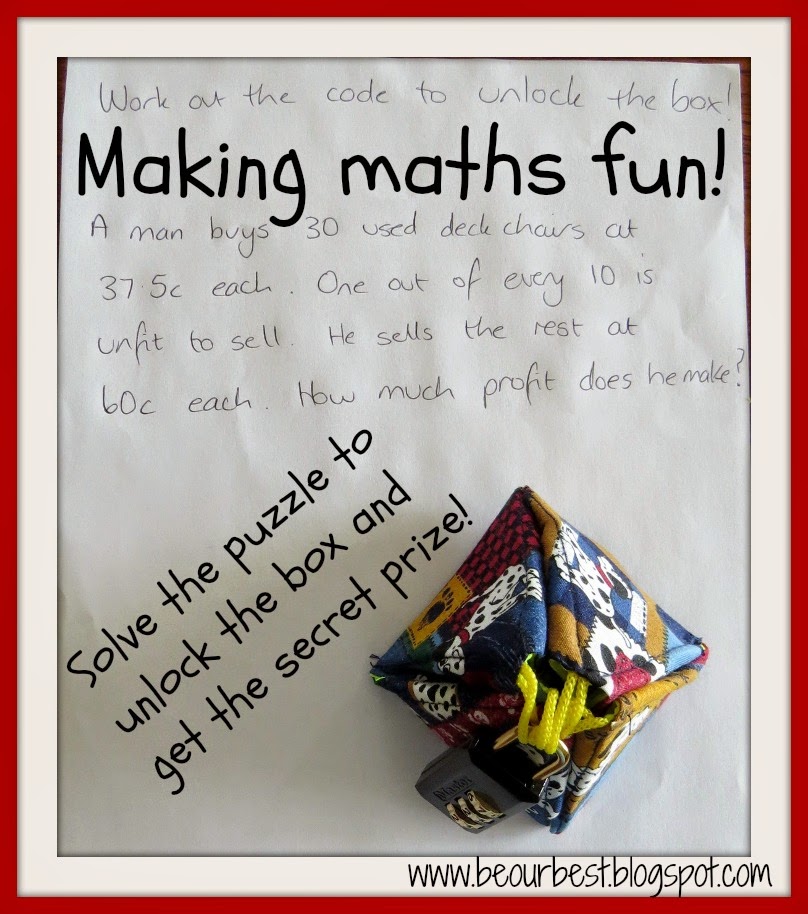
I started out a few months ago, setting maths problems for our daughters, with a reward in a locked box that could only be opened by the combination number of the solution to the maths problem. 

You can read about that here.
The girls enjoyed this, so it grew into a maths advent calendar for Christmas, and now I've had to add an extra box so that they have one each and it's become part of their morning routine to solve a problem and unlock their boxes.

Many of the problems I use for these boxes are from the Maths Olympiad challenge that both girls have participated in at school.


Maths Olympiads

Both our daughters have participated in Maths Olympiads over the past few years at school. It's a 'competition' designed to teach major problem solving strategies and build mathematical intuition in  school kids.

The kids get practice at school in lunch times, and then over the year there are 5 Olympiad tests, each of which consists of 5 questions with around half an hour to solve them in.

The best part of this Maths Olympiads for me is the problem solving practice it gives the students. They learn to use trial and error, estimation and logic to find the answers. The questions are more than just maths problems, they are challenges and puzzles.

 Yes, they do use their mathematical skills to add, subtract, multiply, divide, and make various calculations; but they also learn some nifty mathematical 'tricks' and shortcuts.

For example..

To add consecutive numbers from 1 upwards, take the final number, multiply it by the next consecutive number and divide your answer by 2.

eg:  1+2+3+4+5=    (5 x 6) divided by 2 = 15


Or here's another one my younger daughter taught me:

How to know if any number is divisible by 3:
Add the individual digits and if their sum can be divided by 3, then the original number can be too.

eg  462   4 + 6 + 2 = 12 , which can be divided by 3, so 462 can be too!

There are other divisibility rules which can be found here.

By setting these problems each night I'm learning more myself and also enjoying the challenge of solving the puzzles!


A very tricky problem

When I found this 'viral maths problem' on the internet from last year's Singapore Maths Olympiad, I had to give it a try! It is aimed at Singaporean High School students, and is meant to be a difficult one.

Here is the problem:


Albert and Bernard just became friends with Cheryl, and they want to know when her birthday is. Cheryl marks 10 possible dates: May 15, May 16, May 19, June 17, June 18, July 14, July 16, August 14, August 15, or August 17.
Then Cheryl tells Albert the month of her birthday, but not the day. She tells Bernard the day of her birthday, but not the month. Then she asked if they can figure it out.
Albert: I don't know when Cheryl's birthday is, but I know Bernard doesn't know either.
Bernard: At first I didn't know when Cheryl's birthday is, but now I know.
Albert: If you know, then I know too!
When is Cheryl's birthday?


Tricky isn't it?

Well if you can't figure it out - here's a video to explain how you get the answer:


I had to listen to this and read other explanations a few times before I really understood how to work out the answer!


Make Maths Different and Fun!

Maths as we think of it traditionally - that is 'numbers' can be found in so many aspects of our daily life from shopping and cooking, to bills and banking.  But problem solving is so much more than a maths skill. It's a life skill that will prove a valuable asset to our kids if we get them to practice and enjoy puzzles and problem solving from a young age.

We will continue to look for and take advantage of opportunities to help our kids to develop these skills - whether that be Maths Olympiads or games and puzzles.

Do you know any other ways to make learning maths fun?


Solving maths problems can be fun!


I'm a big believer that there is fun to be found in any task, and as a teacher and a parent - I'm always looking for fun ways to teach and get my girls to practice things.


Just now, we're doing practice with maths problems written in words. To improve a skill, it is important to practice that skill regularly - just like exercising a muscle. 

Practice makes perfect.

Just doing written maths problems isn't that much fun - but I decided to add in a purpose to solving the problems to make my kids want to practice.

I remembered we had a spare combination padlock, which has sat unused in a drawer for a couple of years!
This is one of those padlocks that you can change the combination to whatever number you want, as many times as you want.

So I decided to use this padlock and change the combination to be the answer to maths problems.

As I love sewing and creating new things, I decided to make a little fabric box with loops at the top, that I can loop the padlock through to 'lock' it.


 You could use any kind of container that you can add a lock to. Even an old cereal box with holes punched in could be adapted!

Each day, I plan to put some kind of reward inside the box, perhaps a treat, or a 'voucher' with a reward on like 'get out of stacking the dishwasher today'.

 Then I'll lock it up with the padlock (having set the code for the day) - and leave a word number puzzle for the girls to solve to find the code to unlock the padlock.
The only way they will be able to unlock the box is if they get the maths puzzle answer correct!

I think sometimes I'll give them a puzzle to work out together, and sometimes individual ones. Using this 'unlock the prize' I can give them problems to solve each day - maybe even one in the mornings and the evenings, giving them regular 'exercise' for those problem solving muscles.

Here's what I left for them today when they came home from school. I baked some gingernut cookies - so their reward when they solved the problem was one of those each!
Success! They both did the puzzle and managed to unlock their prize!


What do you think of this idea?

What ways have you found to make maths fun for your kids?


KenKen - fun puzzle arithmetic practice


Ken means Wisdom in Japanese, but the original name for this puzzle was, 

"The Kashikoku Naru Puzzle" 

which means 

"The It Makes you Smarter Puzzle"
(source) 


I first heard of these puzzles when my dad brought these KenKen books out from the UK for our girls. KenKen are a kind of sudoku type puzzle that works on arithmetic and logic. They were invented by a Japanese maths teacher as a way to train young brains in arithmetic in a fun puzzle type manner. In the foreword to each book, the creator, Tetsuya Miyamoto says,

 "It's important that the learning process is enjoyable. KenKen is ideal for making the learning process enjoyable and is perfect for all ages."


How to play

The logic part
Each puzzle has a grid, and like in sudoku and each square in the grid contains a number. If the grid has 3 squares across then those numbers will be 1,2 and 3. If it has 4 squares the numbers will be 1,2,3 and 4; and so on. No number can be repeated in any column or any row.  

Now for the arithmetic part
The small numbers found at the top left corner of a square is the answer to the particular maths function of the numbers in that block. The top of the puzzle will tell you if you are adding, subtracting, multiplying or dividing.

Here's an example of a small multiplication puzzle. In the top right of the page you see a 'x' sign telling you this is a multiplication puzzle.
If you look at the top left corner of each block - this tells you the answer of the numbers in that block multiplied together. So in the top left block there is a 2 which tells us the two numbers in that block must be 1 and 2,  the order of those numbers must then be determined.
If we look at the block on the left below, the number 3 tells us the two numbers in that block must be 1 and 3, so the number in the top left must then be 2, so that the left column has all three numbers present. In the centre of the square that block has a 2, so that one is simple - place a 2 in that box!

The puzzle is worked out using each block in turn.

Here's an example of another puzzle:
You can see at the top right of this page there is a '+'  and a"-" symbol, telling us it's an addition and subtraction puzzle. There are 5 squares across so each row and column must contain the numbers 1,2,3,4 and 5.
The top left block has 2 numbers that added together make 9. Of the numbers we can use, these must be 4 and 5.  Then again the order must be determined. 
Each block must be worked through to work out the numbers and positions,


Fun and educational
These puzzles really are fun to do. They help practice basic arithmetic skills, develop concentration, perseverance and logical thinking, and there are varying levels for all abilities.

You can find KenKen in newspapers, magazines, books and also online and in downloadable apps.
The official KenKen website has daily puzzles, customizable puzzles and free weekly printable email puzzles for teachers to use in classrooms.

Mr Miyamoto developed these puzzles based on his philosophy of 'Teaching without teaching".

Kids will far prefer doing puzzles and games to maths problems and worksheets - but if you find the right puzzles and games they teach the same things!

Have you or your kids ever tried KenKen?

I would definitely recommend giving them a try!


How learning music can help your child with maths


Our eldest daughter is currently learning the clarinet as part of a school music programme.   Sometimes she's keen to practise, other times not so much, but the other day she came home keen to practise saying, "This will help me be better at maths!"  . When I asked her why, she told me that the maths genius in her class at school plays the flute really well, and that music helps you learn maths.


We've all heard that learning music helps with learning maths, but does it really? and how? I decided to do a little research. Here are the areas I found that are helped through music study.


Maths skills learned when studying music


Basic counting skills

Learning rhythm and beats involve counting, so particularly for pre-school children, this helps to provide a good foundation for basic number skills.  Recognising patterns is another basic skill learnt in both music and early elementary maths.


Fractions

Learning music involves learning about whole and part notes and beats I remember learning about half and quarter notes. The division of notes and sections of music is the same skill learned in maths when kids learn fractions, decimals, ratios and proportions.
There is even a curriculum in California, USA where music is being used to teach kids fractions!


Geometry

Spatial awareness skills are said to increase when you learn a musical instrument thanks to the co-ordination necessary to hold and play the instrument together with reading the music.


Memory

Memory is like a muscle - the more you use it the better it gets. In learning music you are memorising things like notes, and how to play them on an instrument and also the sequences of notes needed to play tunes. Maths, particularly basic elementary maths involves learning and memorizing basic facts - like times tables.


Can just listening to music help?


The Mozart Effect

This term was coined after a study carried out in 1993 where people showed an improvement in particular mathematical skills after listening to Mozarts music; which supposedly stimulates particular parts of the brain used in mathematical tasks.  
Further studies question this effect and whether improvements can be made with different types of music - the effect being more on the emotions than on reasoning skills.


If you're interested, here's a fun video of some research done on the street regarding the Mozart effect!


Whether or not listening to music boosts your brain power - I think there are enough similarities in music and maths studies that my daughter is probably right in saying that practising her clarinet more will help her be better at maths - just simply because she is practising a lot of the same skills.  Definitely something to be encouraged!

Do you or your kids play a musical instrument?  Do you believe that this can help with maths studies?